

Why Growth Is Getting Harder:

How AI is Deciding Which Suppliers Get Chosen

Buyer Research Has Shifted.

Historically


  • Google searches

  • Trade media

  • Referrals

  • Sales introductions

  • Trade shows

Today


  • Using A-tools (ChatGPT, Copilot, Claude, Gemini, Grok, Perplexity, and Siri)

  • YouTube "how it works" explanations

  • LinkedIn proof from engineers, operators, and customers

  • Peer Discussion and industry forums

Emerging


  • Without visible evidence of how the company operates, what differentiates its products/services, and where it performs, buyers place their confidence in competitors.

Google still matters. It just matters less than it used to.

When Google shows AI-generated summaries, users click links far less often.

This shifts where trust is earned, from clicks to confirmation.

Ranking and paid ads can still create awareness.

But awareness is no longer the main hurdle.

AI tools elevate what buyers can independently verify across the open web:

Teaching · demonstrations · how it works · real-world explanations · experiences · third-party validation · public visibility

The real burden now is credibility buyers can verify without talking to sales.

Most companies are active, but that activity no longer drives buyer decisions.

Campaigns · content · websites · social activity · trade show presence

Some of it is well executed.

Some of it is effective.

But most companies are only covering part of what buyers now need to decide.

A small number of large, sophisticated industrial organizations have adapted.

That gap is where challenger companies can gain disproportionate ground.

Focused improvements in how proof is created, distributed, and validated can produce outsized gains in trust, demand, and reputation growth.

Marketing didn't stop working. The way the marketplace buys changed.

Before contacting sales, buyers need answers.

What does this company actually do?

How does it work in real operating environments?

Can I defend this choice internally?

If answers aren't easy to find, buyers move on.

Sales isn't failing.

It's being invited in after your buyers’ opinions have already formed.

Buyers form their shortlist before sales ever gets involved.

Buyers don't need more information. They need less doubt.

In industrial purchases, contracts are signed by companies —
but individuals own the outcome.

If it goes wrong, it shows up as:

  • Downtime

  • Safety exposure

  • Missed output

  • Warranty claims

  • Reliability risk

  • Reputation

Buyers look for evidence that makes a decision easier to defend.

Proof creates preference.

Not claims. Not promises.
Buyers trust what’s been proven, not what’s been positioned.

See it work.
Clear, observable proof — real use cases, demonstrations, customers, and references.

Understand why it works.
Straightforward explanations grounded in engineering, experience, and real constraints — not slogans.

Trust it will work for them.
Evidence that’s relevant to their environment, scale, and operating conditions.

Defend the decision internally.
Clear language and examples buyers can share with peers, leadership, and procurement without sounding like marketing.

See it confirmed elsewhere.
Confidence grows when the same proof shows up across independent sources — customers, partners, trade media, industry forums, and live demonstrations.

Evidence-based communication.

From steel, automotive systems, and industrial machinery to data-center infrastructure, medical devices, and advanced components, buyers decide the same way.

SIDEBAR: Gore-Tex

We didn’t tell people Gore-Tex worked.
We proved it.

Gore-Tex manufactures advanced waterproof-breathable fabric membranes.
They don’t make outerwear or footwear — their customers do.

We helped Gore-Tex educate their customers’ customers — first responders, military personnel, and professionals operating in demanding conditions.

That created a challenge: performance isn’t judged in theory.
It’s judged in the rain.

So we built a mobile rain room.
We outfitted people in products made with Gore-Tex.
We let them step into wind and driving rain.

The conversation stopped being:

“Will this keep me dry?”

And became:

“Why would I choose anything else?”

This is how buyers now learn:

  • Experience-based learning

  • Real-world application and performance footage

  • In-field demonstrations

  • Customer installations and use cases

  • Clear, practical “how it works” explanations

  • Education from engineers and operators

  • Expert commentary and category leadership

  • Coverage in trade publications and industry forums

  • Independent reviews and third-party validation

And it has to live where buyers actually learn:

LinkedIn and YouTube — with your website supporting the ‘system,’ not carrying it alone.

This is where buying decisions actually form.

If AI can't find your company’s ‘proof,’ it can't recommend you.

AI tools don’t create credibility.
They surface and reflect what already exists across the open web.

AI tools don’t create credibility.
They surface and reflect what already exists across the open web.
If your company’s proof isn’t visible and ongoing,
it won’t appear in answers —
and sales won’t make the shortlist or get the call.

Across portfolio companies, this compounds into slower organic growth —
not because value propositions are weak,
but because buyer confidence forms elsewhere.

The result: longer cycles, price pressure, and compressed multiples.

Today, companies must act like publishers, creating and distributing their proof consistently across multiple channels.

I partner with executive teams in transition to:

Translate real capability into market confidence — so sales gets the call.

Diagnostically
Identify visibility gaps and proof deficits before they quietly remove the company from buyer consideration.

Strategically
Design commercial infrastructure that preserves what made the business valuable — and makes it clear to modern buyers.

Executionally
Operationalize real-world proof — explanations, demonstrations, validation — across the channels buyers actually use to decide.

Buyers decide before sales gets involved. That’s where I work.

I’ve sat in the operator’s seat, and built commercial systems that work.

Marketing Werks
Led company growth to a successful exit

$2M - $100M

Led the scaling of a Fortune 500–focused agency, generating 80% of net-new business growth:

  • Bridgestone

  • Discover Card

  • GM

  • Lego

  • Nike

  • PlayStation

  • Target

  • United Healthcare

  • Verizon

agencyEA
Led company-wide change management

28%

Revenue growth

100%

Client retention

98%

Team retention

AKA Partners
Led commercial transformation leading to acquisition

100%

Client transition to direct enterprise (from 98% sub-supplier)

  • Ace Hardware

  • Astellas Pharma

  • FCL Builders

  • FabTech-IGM

  • Kimberly-Clark

  • SAC Wireless, A Nokia Company

CLOSE-UP: AI-Driven Research

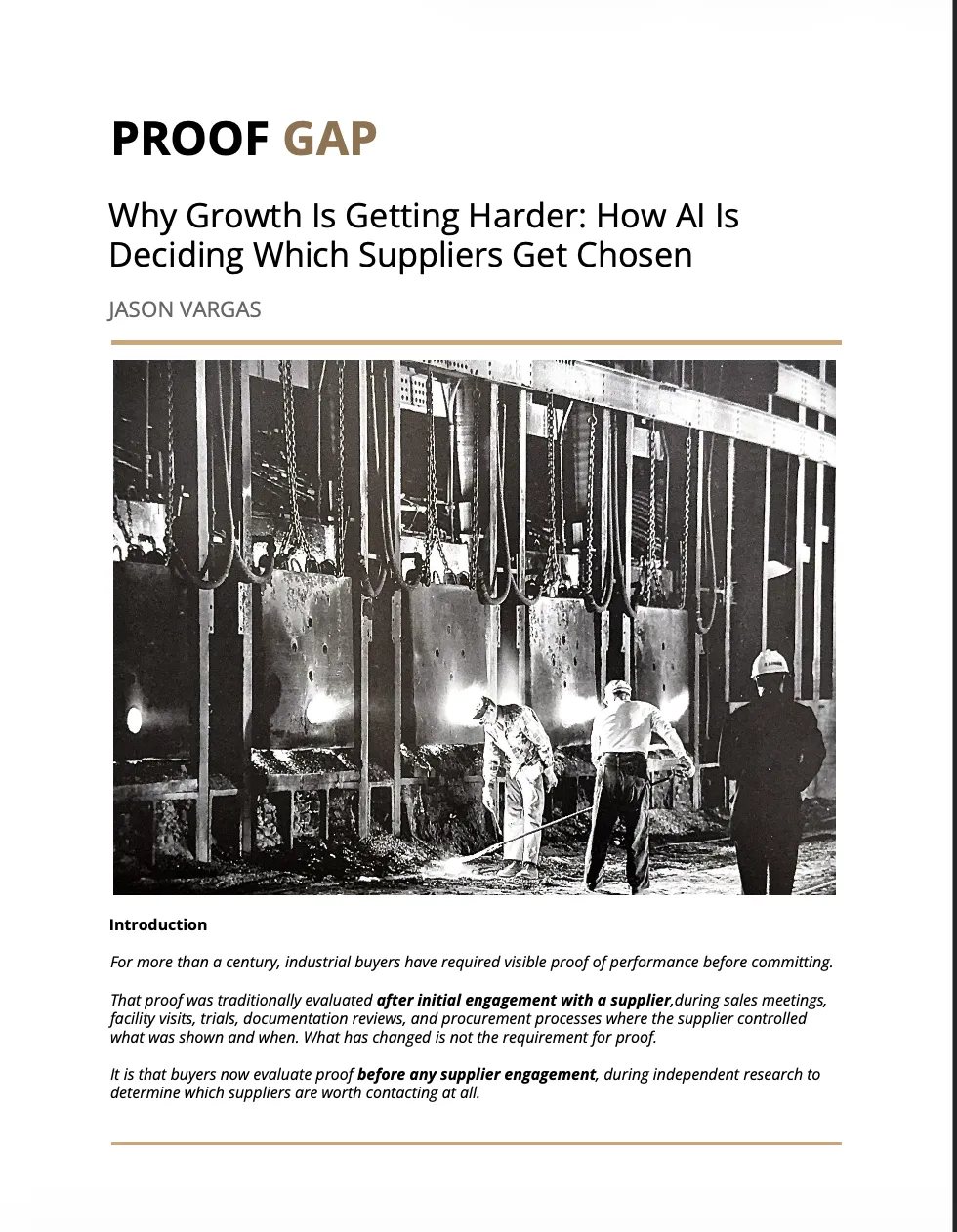
The Proof Gap explains why capable industrial and B2B companies are increasingly excluded before sales is ever contacted—even when their products, teams, and performance remain strong.The paper examines what has changed in buyer research, how many organizations react by increasing activity or messaging, and why those responses often overcorrect and fail to restore consideration. It concludes by reframing the issue as a leadership decision and outlines what leaders must do differently to remain visible and credible while buyers decide who to trust.

Jason Vargas

312-961-1977

Chicago-based · Open to travel